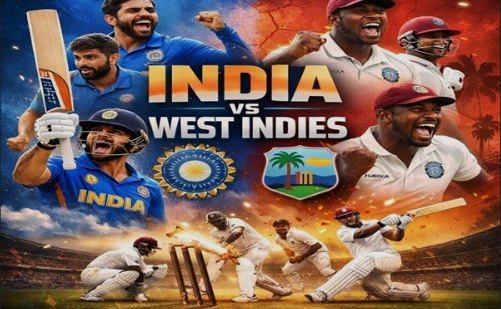
The rivalry between the West Indies Cricket Team and the India National Cricket Team is a journey through eras of dominance, resistance, and transformation. What began as a one-sided contest soon evolved into a gripping battle filled with iconic performances, emotional moments, and shifting power dynamics. From the fearsome Caribbean pace attacks to India’s rise as a confident cricketing force, every phase added a new layer to this story. Scorecards tell the numbers, but behind them lie tales of courage, strategy, and unforgettable clashes that shaped cricket history.
Tournament
Venue
Date
Toss
India Score
West Indies Score
Result
Series
Player of the Match
ICC T20 World Cup
Kolkata
Mar 1, 2026
India (field)
199/5 (19.2)
195/4 (20)
India won by 5 wickets
World Cup Super 8
Sanju Samson (IND)
Bilateral Test
Delhi
Oct 10, 2025
India (bat)
518/5d & 124/3
248 & 390 (f/o)
India won by 7 wickets
Bilateral Test
Kuldeep Yadav (IND)
Bilateral Test
Ahmedabad
Oct 2, 2025
W. Indies (bat)
448/5d
162 & 146
India won by innings & 140 runs
Bilateral Test
Ravindra Jadeja (IND)
Bilateral T20I
Lauderhill
Aug 13, 2023
India (bat)
165/9 (20)
171/2 (18)
West Indies won by 8 wickets
Bilateral T20I
Romario Shepherd (WI)
Bilateral T20I
Lauderhill
Aug 12, 2023
W. Indies (bat)
179/1 (17)
178/8 (20)
India won by 9 wickets
Bilateral T20I
Yashasvi Jaiswal (IND)
Bilateral T20I
Providence
Aug 8, 2023
W. Indies (bat)
164/3 (17.5)
159/5 (20)
India won by 7 wickets
Bilateral T20I
Suryakumar Yadav (IND)
Bilateral T20I
Providence
Aug 6, 2023
India (bat)
152/7 (20)
155/8 (18.5)
West Indies won by 2 wickets
Bilateral T20I
Nicholas Pooran (WI)
All-Time Head-to-Head Record
Format
Matches Played
India Won
West Indies Won
Tied/Draw/NR
Test Matches
100
23
30
47 (Draws)
ODI Matches
142
72
64
2 (T), 4 (NR)
T20I Matches
31
20
10
1 (NR)
TOTAL
273
115
104
54
All-Time Batting Leaders
Player
Team
Span
Format(s)
Total Runs
Virat Kohli
IND
2009–2023
Combined
2,261
Sunil Gavaskar
IND
1971–1987
Test
2,749
Sachin Tendulkar
IND
1991–2013
Combined
3,203
Clive Lloyd
WI
1966–1985
Test/ODI
2,344
Vivian Richards
WI
1974–1991
Test/ODI
2,924
Shivnarine Chanderpaul
WI
1994–2015
Combined
2,171
All-Time Bowling Leaders
Player
Team
Format(s)
Total Wickets
Best Figures
R. Ashwin
IND
Combined
103
12/131
Malcolm Marshall
WI
Test/ODI
95
11/89
Kapil Dev
IND
Test/ODI
89
9/83
Harbhajan Singh
IND
Combined
91
7/33
Anil Kumble
IND
Test/ODI
74
6/12
Courtney Walsh
WI
Test/ODI
65
6/18
When Caribbean Fire Met Indian Resilience
The early encounters between the West Indies and India were a tale of sheer dominance meeting quiet determination. When the West Indies Cricket Team first faced the India National Cricket Team in the 1950s, the contrast was striking. The Caribbean side brought explosive pace, flair, and confidence, while India relied on patience, technique, and endurance. Matches often tilted heavily in favor of West Indies, thanks to their powerful batting lineup and emerging fast bowlers. India struggled to cope with the bounce and aggression, leading to several one-sided scorecards in the early years. Yet, beneath those defeats, seeds of resilience were being sown. Indian batters began adapting, learning to face hostile bowling with grit and discipline. These early clashes were more than just results on a scoreboard; they were lessons in survival and growth. Over time, this phase laid the foundation of a rivalry that would evolve from dominance to competition, where respect slowly replaced fear and belief began to challenge supremacy.
Year
Venue
Winner
Key Highlight
1952
India
West Indies
First-ever Test series between the teams
1953
West Indies
West Indies
Dominant home performance
1958
India
West Indies
Strong batting display by Caribbean side
1962
West Indies
West Indies
Pace attack troubles Indian batters
1967
India
West Indies
Signs of Indian resistance begin
The Era of Fear: West Indies Pace Battery vs Indian Batting Lineup
The 1970s and 1980s marked a chilling chapter in the rivalry, when the West Indies Cricket Team unleashed one of the most feared pace attacks in cricket history against the India National Cricket Team. Names like Michael Holding, Andy Roberts, Malcolm Marshall, and Joel Garner created an atmosphere of pure intimidation. Their pace, accuracy, and relentless short-pitched bowling tested not just technique but courage. Indian batters, more accustomed to spin-friendly conditions, often found themselves under physical and mental pressure, resulting in low scores and frequent collapses. Scorecards from this era regularly reflected West Indies’ dominance, with innings defeats and large margins becoming common. Yet, even in this storm, players like Sunil Gavaskar stood tall, showing that discipline and skill could counter raw pace. These encounters were not just cricket matches but battles of survival, where every run felt earned and every wicket hard-fought. This era defined the rivalry’s intensity, embedding a sense of fear, respect, and fierce competition that would echo for decades.
Year
Venue
Winner
Key Highlight
1976
West Indies
West Indies
Dominant pace bowling display
1979
India
West Indies
Indian batting struggles vs fast attack
1983
West Indies
West Indies
Relentless short-pitch strategy
1984
India
West Indies
Series marked by pace intimidation
1987
West Indies
West Indies
Continued dominance with fast bowlers
1983 and the Night That Changed Everything
The rivalry between the West Indies Cricket Team and the India National Cricket Team witnessed its most defining moment during the 1983 Cricket World Cup Final at Lord’s. Until that night, West Indies were the undisputed giants of world cricket, while India were still seen as underdogs. Led by Kapil Dev, India stunned the world by defending a modest total of 183. The match was filled with tension, belief, and turning points that reshaped cricket history. The early dismissal of Viv Richards, thanks to Kapil Dev’s iconic running catch, shifted momentum dramatically. West Indies, known for their powerful batting, collapsed under pressure, getting bowled out for 140. This victory was not just about a scorecard; it was a statement that fear could be conquered. It ignited belief in Indian cricket and changed the global balance of power. That night transformed the rivalry from one-sided dominance into a competitive battle, where India proved they could stand tall against the mightiest force in cricket.
Year
Venue
Winner
Key Highlight
1983
Lord’s
India
Defended 183 in World Cup Final
1983
Lord’s
India
Kapil Dev’s iconic catch of Viv Richards
1983
Lord’s
India
West Indies bowled out for 140
1983
Lord’s
India
First World Cup title for India
1983
Lord’s
India
Turning point in rivalry history
From Underdogs to Contenders
The late 1980s and 1990s marked a steady transformation in the rivalry between the West Indies Cricket Team and the India National Cricket Team. After the historic breakthrough in 1983, India no longer entered contests with fear but with growing belief. While West Indies still possessed strength and flair, their aura of invincibility began to fade. India started winning crucial matches, especially at home, where spin-friendly conditions allowed their bowlers to control the game. Players like Mohammad Azharuddin and Anil Kumble brought stability and match-winning ability, while the Caribbean side relied on legends like Brian Lara to maintain dominance. Matches became tighter, with scorecards reflecting competitive totals and closely fought finishes rather than one-sided results. This phase saw the rivalry evolve into a true contest, where both teams pushed each other tactically and mentally. India’s rise from underdogs to serious contenders was not sudden but built on consistent performances, resilience, and a belief that they could challenge even the most dominant sides in world cricket.
Year
Venue
Winner
Key Highlight
1989
India
India
Strong home performance
1993
India
India
Spin attack dominates
1997
West Indies
Draw
Closely contested Test series
1998
India
India
Balanced team effort
1999
West Indies
West Indies
Lara’s match-winning brilliance
Icons Collide: Tendulkar vs Lara Era
As the rivalry matured into the late 1990s and early 2000s, it found its heartbeat in the clash between two modern legends, Sachin Tendulkar and Brian Lara. Whenever the India National Cricket Team faced the West Indies Cricket Team, fans were not just watching a match, they were witnessing a duel of brilliance. Tendulkar’s precision, balance, and hunger for runs contrasted beautifully with Lara’s elegance, flair, and ability to dominate bowling attacks single-handedly. Scorecards from this era often featured monumental innings, with both players rescuing their teams from difficult situations or turning matches with sheer class. Whether it was Tendulkar’s composed centuries under pressure or Lara’s breathtaking stroke play that dismantled bowling units, these performances elevated the rivalry to a new level. The contests became less about team dominance and more about individual moments of genius. This era added glamour, excitement, and global attention, ensuring that every encounter carried the weight of expectation and the promise of something unforgettable.
Year
Venue
Winner
Key Highlight
1994
India
India
Tendulkar’s match-winning innings
1997
West Indies
Draw
Lara’s dominant batting display
2002
West Indies
India
Tendulkar century under pressure
2006
India
West Indies
Balanced contest with key performances
2007
West Indies
West Indies
Lara leads from the front
Test Battles That Tested Character
The longest format revealed the true soul of the rivalry between the West Indies Cricket Team and the India National Cricket Team. Test matches were never just about runs and wickets; they were about patience, endurance, and mental strength. On slow Indian pitches, spinners dictated terms, while in the Caribbean, bounce and pace tested technique. Players like Rahul Dravid became symbols of resilience, grinding attacks for hours, while Shivnarine Chanderpaul stood firm with his unorthodox yet effective style. These matches often stretched into tense draws or dramatic finishes, where a single session could flip the result. Scorecards from these encounters reflected grit, with long partnerships, hard-earned centuries, and bowlers working tirelessly for breakthroughs. Series were defined not by dominance but by character, where teams had to adapt to unfamiliar conditions and sustained pressure. This phase of the rivalry highlighted the beauty of Test cricket, showing that beyond aggression and flair, it was determination and discipline that ultimately shaped outcomes and etched these battles into cricketing history.
Year
Venue
Winner
Key Highlight
2002
West Indies
Draw
Hard-fought Test series
2006
West Indies
India
Historic Test series win overseas
2011
India
India
Dominant home performance
2016
West Indies
India
Strong bowling display by India
2019
West Indies
India
Complete dominance in Test series
Conclusion
Over decades, the rivalry between the West Indies Cricket Team and the India National Cricket Team has transformed into a symbol of cricket’s evolving spirit. From dominance to balance and now modern competitiveness, each encounter reflects growth, adaptation, and passion. Legendary players, dramatic matches, and changing tactics have kept this rivalry alive across generations. While results may shift, the intensity and respect remain constant. This timeline is not just about scorecards or stats, but about how two cricketing cultures pushed each other to evolve, leaving behind a legacy that continues to inspire fans worldwide.