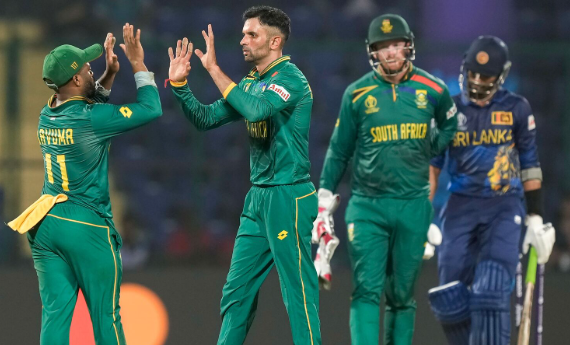
The rivalry between the South Africa National Cricket Team and the Sri Lanka National Cricket Team reflects a fascinating contest between power and skill in international cricket. South Africa’s pace strength meets Sri Lanka’s spin mastery, creating a balanced and evolving rivalry. Over the years, their encounters have delivered memorable performances across all formats.
Recent South Africa vs Sri Lanka Encounters
Tournament
Venue
Date
Result
Test (2nd)
St George’s Park, Gqeberha
Dec 5-9, 2024
South Africa won by 109 runs
Test (1st)
Kingsmead, Durban
Nov 27-30, 2024
South Africa won by 233 runs
T20 World Cup
Nassau County Stadium, New York
Jun 3, 2024
South Africa won by 6 wickets
ODI World Cup
Arun Jaitley Stadium, Delhi
Oct 7, 2023
South Africa won by 102 runs
T20I (Bilateral)
Sharjah Cricket Stadium
Oct 30, 2021
South Africa won by 4 wickets
T20I (Bilateral)
R Premadasa, Colombo
Sep 14, 2021
South Africa won by 10 wickets
T20I (Bilateral)
R Premadasa, Colombo
Sep 12, 2021
South Africa won by 9 wickets
T20I (Bilateral)
R Premadasa, Colombo
Sep 10, 2021
South Africa won by 28 runs
ODI (Bilateral)
R Premadasa, Colombo
Sep 7, 2021
Sri Lanka won by 78 runs
ODI (Bilateral)
R Premadasa, Colombo
Sep 4, 2021
South Africa won by 67 runs (D/L)
ODI (Bilateral)
R Premadasa, Colombo
Sep 2, 2021
Sri Lanka won by 14 runs
T20I (Bilateral)
Wanderers, Johannesburg
Mar 24, 2019
South Africa won by 45 runs (D/L)
T20I (Bilateral)
SuperSport Park, Centurion
Mar 22, 2019
South Africa won by 16 runs
T20I (Bilateral)
Newlands, Cape Town
Mar 19, 2019
Match tied (SA won Super Over)
ODI World Cup
Riverside Ground, England
Jun 28, 2019
South Africa won by 9 wickets
Overall Head-to-Head Record
Format
Matches Played
South Africa Won
Sri Lanka Won
Tied/Drawn
South Africa Win %
Test
33
18
9
6
54.5%
ODI
~80+
46
33
1
~57%
T20I
18
12
5
1
66.7%
Overall
~131
76
47
8
58%
Key Performers Across Formats
Player
Team
Format Focus
Matches
Runs (Avg)
Wickets (Avg)
Centuries/Five-Wicket Hauls
Notable Strength
Temba Bavuma
SA
Test
Recent series
High
N/A
Multiple 100s
Leadership & consistency
Aiden Markram
SA
All
10+
Strong
N/A
1 (ODI WC)
Aggressive middle-order batting
Kagiso Rabada
SA
Test/T20I
Many
N/A
High
Multiple 5-wicket hauls
Pace & swing
Kusal Perera
SL
Test
Key
153* standout
N/A
1 iconic
Fighting spirit in chases
Quinton de Kock
SA
ODI
Many
174 standout
N/A
Multiple
Explosive opening
Keshav Maharaj
SA
Test
Recent
N/A
Good
Spin control
Economy in sub-continent style
Early Encounters and First Meetings (1992–1999)
The rivalry began after South Africa’s return to international cricket in 1992. Sri Lanka, already an established team, faced a strong South African side eager to make an impact. Early matches were competitive, with South Africa often having the upper hand due to their disciplined pace attack and structured gameplay. Sri Lanka, however, showed resilience and gradually adapted to the challenge. The contests gained more attention after Sri Lanka’s rise in the mid-1990s, especially following their 1996 World Cup success. These early encounters laid the foundation of a rivalry that balanced South Africa’s consistency with Sri Lanka’s flair and unpredictability.
Year
Event
Winner
Venue
1992
First ODI
South Africa
New Zealand
1996
World Cup
Sri Lanka
India
1999
World Cup
South Africa
England
Sri Lanka’s Golden Era Impact (2000–2007)
Between 2000 and 2007, Sri Lanka entered a golden phase with a strong lineup of experienced players. During this period, matches against South Africa became highly competitive. Sri Lanka’s batting strength and spin attack challenged South Africa effectively, particularly in subcontinental conditions. South Africa remained a powerful side, often dominating in home conditions with their pace bowling. The rivalry during this era was well-balanced, with both teams winning crucial matches. These years produced several memorable encounters, highlighting the contrasting strengths of both teams and elevating the rivalry’s global appeal.
Year
Series/Event
Winner
Highlight
2003
World Cup
Sri Lanka
Strong Batting
2006
ODI Series
South Africa
Home Dominance
2007
World Cup
South Africa
Competitive Clash
South Africa’s Dominance and Consistency (2008–2015)
From 2008 to 2015, South Africa established a period of dominance over Sri Lanka across formats. Their strong pace attack and experienced batting lineup gave them a consistent edge. Sri Lanka, despite having talented players, struggled to match South Africa’s overall balance and consistency, especially in overseas conditions. Matches were still competitive, but South Africa often emerged victorious. This era highlighted South Africa’s strength as a top-ranked team while also showcasing Sri Lanka’s ability to produce occasional standout performances.
Year
Format
Winner
Highlight
2009
ODI Series
South Africa
Strong Batting
2012
Test Series
South Africa
Away Success
2015
World Cup
South Africa
Dominant Win
Sri Lanka’s Resilience and Key Victories (2016–2019)
Between 2016 and 2019, Sri Lanka showed resilience and managed to challenge South Africa more effectively. They achieved notable victories, particularly in home conditions where spin played a crucial role. South Africa remained competitive but faced tougher contests during this period. Matches became more unpredictable, with Sri Lanka capitalizing on their strengths. This phase brought renewed excitement to the rivalry, as Sri Lanka proved capable of defeating a strong South African side.
Year
Event
Winner
Highlight
2016
Test Series
Sri Lanka
Clean Sweep
2017
ODI Series
South Africa
Comeback
2019
T20 Series
Sri Lanka
Competitive Wins
Modern Era and T20 Influence (2020–2022)
The rise of T20 cricket added a new dimension to the rivalry. Matches became faster-paced, with aggressive batting and innovative strategies shaping outcomes. South Africa adapted well to the format, while Sri Lanka focused on rebuilding with young talent. Encounters during this period were closely contested, reflecting the evolving nature of cricket. Both teams showcased adaptability, making their clashes exciting and unpredictable for fans.
Year
Format
Winner
Highlight
2020
T20 Series
South Africa
Strong Performance
2021
ICC Event
South Africa
Consistency
2022
Bilateral Series
N/A
Balanced Matches
Recent Years and Emerging Talent (2023–Present)
In recent years, both teams have introduced new players, bringing fresh energy to the rivalry. South Africa continues to rely on a strong core of experienced players, while Sri Lanka is rebuilding with emerging talent. Matches have become more dynamic, with both teams capable of delivering strong performances. The rivalry now reflects a blend of youth and experience, making future encounters highly anticipated. This phase highlights the ongoing evolution of both teams in international cricket.
Year
Series/Event
Highlight
2023
Bilateral Series
Strong Win
2024
ICC Event
Competitive Match
2025
Future Fixtures
Anticipated Clash
Key Players and Match-Winning Contributions
The South Africa vs Sri Lanka rivalry has been shaped by legendary players from both sides. South Africa’s icons like Jacques Kallis and AB de Villiers have delivered consistent performances, while Sri Lanka’s legends such as Kumar Sangakkara and Muttiah Muralitharan have made significant impacts. These players have defined matches with their skill and leadership. Individual brilliance has often been the deciding factor, adding excitement and depth to the rivalry.
Player
Team
Era
Contribution
Jacques Kallis
South Africa
1990s–2010s
All-round Excellence
AB de Villiers
South Africa
2000s–2010s
Explosive Batting
Kumar Sangakkara
Sri Lanka
2000s–2010s
Consistent Batter
Muttiah Muralitharan
Sri Lanka
1990s–2010s
Spin Legend
Rivalry Significance and Global Impact
The South Africa vs Sri Lanka rivalry holds an important place in international cricket. It represents contrasting styles and competitive spirit, contributing to the sport’s global appeal. Matches between these teams attract attention for their quality and unpredictability. The rivalry has evolved over decades, adapting to new formats and changing team dynamics. It continues to inspire players and entertain fans worldwide, maintaining its significance in modern cricket.
Aspect
South Africa
Sri Lanka
Impact
Strength
Pace Attack
Spin Bowling
Balanced Rivalry
Challenge
Subcontinent Conditions
Overseas Performance
Growth
Future
Strong Contender
Rebuilding Team
Exciting Matches
Conclusion
The timeline of the South Africa National Cricket Team vs Sri Lanka National Cricket Team rivalry reflects decades of competitive cricket and evolving strategies. South Africa’s consistency and pace strength have often given them an edge, while Sri Lanka’s skill and resilience have produced memorable victories. From early encounters to modern T20 clashes, the rivalry continues to evolve with new talent and changing dynamics. Both teams have contributed iconic players and unforgettable matches, ensuring its lasting appeal. As cricket grows globally, this rivalry remains significant, promising exciting contests and showcasing the balance between power and finesse in international cricket.