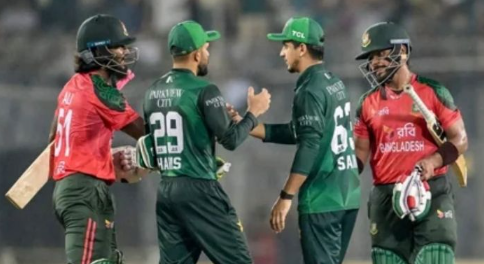
The rivalry between the Bangladesh National Cricket Team and the Pakistan National Cricket Team is a compelling story of growth, dominance, and resilience. While Pakistan enjoyed early superiority, Bangladesh’s steady rise has transformed this contest into a competitive and emotionally charged rivalry, especially in recent years across formats.
Last Key Encounters
Date
Format
Venue
Match Summary
Result
Margin
Highlight / Key Moment
15 Mar 2026
ODI (3rd)
Sher-e-Bangla, Dhaka
BAN 290/5 (50) vs PAK 279 (50)
Bangladesh won
11 runs
Tanzid Hasan starred; Bangladesh sealed 2-1 series win!
13 Mar 2026
ODI (2nd)
Sher-e-Bangla, Dhaka
PAK 274 (47.3) vs BAN 114 (23.3) (DLS)
Pakistan won
128 runs (DLS)
Maaz Sadaqat’s explosive 75 turned the game; rain helped PAK
11 Mar 2026
ODI (1st)
Sher-e-Bangla, Dhaka
PAK 114 (30.4) vs BAN 115/2 (15.1)
Bangladesh won
8 wickets
Nahid Rana’s bowling masterclass; historic low total for PAK
25 Sep 2025
T20I (Asia Cup)
Dubai International Cricket Stadium
PAK 135 vs BAN 124
Pakistan won
11 runs
Tight thriller; Pakistan defended a modest total brilliantly
24 Jul 2025
T20I (3rd)
Sher-e-Bangla, Dhaka
PAK 178/7 (20) vs BAN 104 (16.4)
Pakistan won
74 runs
Sahibzada Farhan 63*; Salman Mirza took 3/19
22 Jul 2025
T20I (2nd)
Sher-e-Bangla, Dhaka
BAN 133 (20) vs PAK 125 (19.2)
Bangladesh won
8 runs
Jaker Ali 55* heroics; Shoriful Islam 3/17 in death overs
20 Jul 2025
T20I (1st)
Sher-e-Bangla, Dhaka
PAK 110 (19.3) vs BAN 112/3 (15.3)
Bangladesh won
7 wickets
First time BAN bowled out PAK in T20Is! Taskin Ahmed 3/22
3 Sep 2024
Test (2nd)
Rawalpindi Cricket Stadium
PAK 274 & 172 vs BAN 262 & 185/4
Bangladesh won
6 wickets
Historic series win for Bangladesh in Pakistan!
21–25 Aug 2024
Test (1st)
Rawalpindi Cricket Stadium
PAK 448/6d & 146 vs BAN 565 & 30/0
Bangladesh won
10 wickets
Mushfiqur Rahim & Zakir Hasan masterclass; BAN’s first Test win in Pakistan
Win Percentage Comparison Table
Format
Total Matches
Australia Wins
Sri Lanka Wins
Draws / NR
Australia Win %
Sri Lanka Win %
Tests
35
22
5
8
62.86%
14.29%
ODIs
105
64
37
4
60.95%
35.24%
T20Is
28
17
11
0
60.71%
39.29%
Overall
168
103
53
12
61.31%
31.55%
Memorable Matches Timeline Table
Date
Format
Venue
Match Summary
Result
Margin
Highlight / Key Moment
16 Feb 2026
T20I (T20 WC)
Pallekele International Cricket Stadium
AUS 181 vs SL 184/2 (18 ov)
Sri Lanka won
8 wickets
Pathum Nissanka’s century powered SL into Super 8s
12 Feb 2026
T20I (Bilateral)
R. Premadasa Stadium, Colombo
AUS 158/6 vs SL 154/9
Sri Lanka won
4 runs
Nail-biting thriller; SL defended brilliantly
10 Feb 2026
T20I (Bilateral)
Pallekele, Kandy
SL 142/3 (17.2 ov) vs AUS 141/8
Sri Lanka won
7 wickets
Comfortable chase sealed SL series momentum
14 Feb 2025
ODI (2nd)
R. Premadasa Stadium, Colombo
SL 281/4 vs AUS 107 (24.2 ov)
Sri Lanka won
174 runs
SL’s biggest-ever ODI win over Australia
11 Feb 2025
ODI (1st)
R. Premadasa Stadium, Colombo
SL 214 vs AUS 165 (33.5 ov)
Sri Lanka won
49 runs
SL swept 2-0 ODI series in style
28 Jan 2025
Test (1st)
Galle International Stadium
AUS 654/6d vs SL 165 & 247
Australia won
Innings & 242 runs
AUS posted massive total; SL collapsed twice
17 Mar 1996
ODI (WC Final)
Gaddafi Stadium, Lahore
AUS 241/6 vs SL 245/3 (46.2 ov)
Sri Lanka won
7 wickets
Aravinda de Silva’s 107* + 3 wickets; SL’s first WC title!
Greatest Individual Heroics in SL vs AUS Matches
Rank
Player
Team
Match / Date
Performance
Impact / Why Iconic
1
Aravinda de Silva
SL
1996 WC Final
107* (124) + 3/42
All-round masterclass; won SL their first World Cup
2
Pathum Nissanka
SL
T20 WC 2026
Century in successful chase
Match-winning knock; SL knocked AUS out of contention
3
Kusal Mendis
SL
2nd ODI, Feb 2025
101 runs (key innings)
Anchored massive 281/4; set up record 174-run victory
4
Glenn Maxwell
AUS
T20I, Feb 2026
Explosive 60+ in losing cause
Power-hitting brilliance even in defeat
5
Wanindu Hasaranga
SL
Multiple T20Is 2025-26
Match-winning all-round display
Spin wizard + crucial batting; series hero
Early Encounters: Pakistan’s Dominance (1986–2003)
The initial phase of this rivalry was heavily dominated by Pakistan, a well-established cricketing nation with a rich history and experienced players. Bangladesh, still developing as a competitive international side, struggled to match Pakistan’s consistency and tactical strength. Matches were often one-sided, with Pakistan’s strong bowling attack and reliable batting lineup securing comfortable victories. However, these encounters played a crucial role in Bangladesh’s development, providing valuable exposure at the highest level. Despite the losses, Bangladesh showed determination and gradual improvement. This period reflected the clear gap between the two teams but also laid the groundwork for Bangladesh’s future progress in international cricket.
Year
Event
Winner
Venue
1986
Asia Cup
Pakistan
Asia
1999
World Cup
Pakistan
England
2003
World Cup
Pakistan
South Africa
Bangladesh’s Breakthrough: First Signs of Resistance (2004–2010)
Between 2004 and 2010, Bangladesh began to show signs of improvement, turning the rivalry slightly more competitive. Their historic victory over Pakistan in 1999 inspired confidence, and they started challenging stronger teams with greater belief. While Pakistan still held the upper hand, Bangladesh’s performances became more spirited. Matches were no longer completely one-sided, and Bangladesh managed to push Pakistan into tighter situations. This period marked the beginning of Bangladesh’s transition from underdogs to a team capable of competing with established nations. The rivalry started gaining more interest as Bangladesh’s potential became increasingly evident.
Year
Series/Event
Winner
Highlight
2004
Bilateral Series
Pakistan
Competitive Games
2007
World Cup
Pakistan
Strong Performance
2010
Asia Cup
Pakistan
Close Contest
Pakistan’s Continued Control in ICC Events (2011–2014)
During this period, Pakistan maintained its dominance, particularly in ICC tournaments. Their experience and depth allowed them to handle pressure situations more effectively than Bangladesh. Matches were competitive at times, but Pakistan often found ways to secure victories. Bangladesh continued to improve, gaining valuable experience and strengthening their squad. This phase highlighted Pakistan’s ability to perform consistently at the highest level while Bangladesh worked towards closing the gap. The rivalry remained one-sided in terms of results, but the competitive spirit of Bangladesh kept matches engaging.
Year
Event
Winner
Highlight
2011
World Cup
Pakistan
Solid Win
2012
Asia Cup
Pakistan
Final Appearance
2014
T20 World Cup
Pakistan
Strong Campaign
Turning Point: Bangladesh’s Rise at Home (2015–2017)
The rivalry took a dramatic turn between 2015 and 2017 when Bangladesh achieved significant success, particularly in home conditions. Their ODI series win against Pakistan in 2015 marked a historic milestone and boosted their confidence. Bangladesh’s improved batting lineup and effective spin attack allowed them to challenge Pakistan more effectively. Matches became highly competitive, with Bangladesh securing memorable victories. This period marked a shift in the balance of power, as Bangladesh emerged as a strong contender. The rivalry gained new intensity, with both teams pushing each other to perform at their best.
Year
Series
Winner
Highlight
2015
ODI Series
Bangladesh
Historic Whitewash
2016
Asia Cup
Bangladesh
Final Appearance
2017
ICC Event
Pakistan
Competitive Matches
Modern Rivalry: Balanced and Competitive (2018–Present)
In recent years, the Bangladesh vs Pakistan rivalry has become more balanced and competitive. Both teams have developed strong squads with talented players, making matches unpredictable. Pakistan continues to rely on its pace attack and dynamic batting, while Bangladesh focuses on consistency and home advantage. Matches are often closely contested, reflecting the narrow gap between the teams. This period represents the peak of competitiveness in the rivalry, with both sides capable of winning on any given day. The contests continue to attract global attention due to their intensity and excitement.
Year
Series/Event
Winner
Highlight
2019
World Cup
Pakistan
Strong Performance
2021
T20 Series
Pakistan
Competitive Games
2023
Bilateral Series
N/A
Balanced Matches
Key Players and Match-Winning Performances
The rivalry has been shaped by several standout players who have delivered match-winning performances. Bangladesh has relied on stars like Shakib Al Hasan and Tamim Iqbal, while Pakistan has been guided by players such as Babar Azam and Shaheen Afridi. These players have often influenced the outcomes of crucial matches. Their performances have added excitement and intensity to the rivalry, creating memorable moments for fans.
Player
Team
Era
Contribution
Shakib Al Hasan
Bangladesh
Modern Era
All-round Excellence
Tamim Iqbal
Bangladesh
Modern Era
Batting Strength
Babar Azam
Pakistan
Modern Era
Batting Leader
Shaheen Afridi
Pakistan
Modern Era
Fast Bowling
Future Outlook: A Rivalry That Keeps Growing
The future of the Bangladesh vs Pakistan rivalry looks promising as both teams continue to evolve. Bangladesh’s steady improvement and Pakistan’s strong cricketing tradition ensure competitive encounters. Regular matches in ICC tournaments and bilateral series will further strengthen this rivalry. With emerging talent and improved performances, future contests are expected to be even more exciting. This rivalry represents the growth of international cricket, where developing teams challenge established powers and create thrilling, unpredictable matches.
Aspect
Bangladesh
Pakistan
Impact
Strength
Spin & All-rounders
Pace Attack
Balanced Rivalry
Challenge
Consistency
Stability
Close Matches
Future
Rising Team
Strong Legacy
Exciting Games
Conclusion
The timeline of the Bangladesh National Cricket Team vs Pakistan National Cricket Team rivalry reflects a journey of transformation and growing competitiveness. From Pakistan’s early dominance to Bangladesh’s rise as a strong contender, the rivalry has evolved into an exciting contest. Both teams have delivered memorable matches filled with skill and determination. As they continue to compete on the international stage, their encounters promise even greater intensity and drama. This rivalry highlights the dynamic nature of modern cricket, where emerging teams challenge established nations, contributing to the sport’s global appeal and competitive spirit.