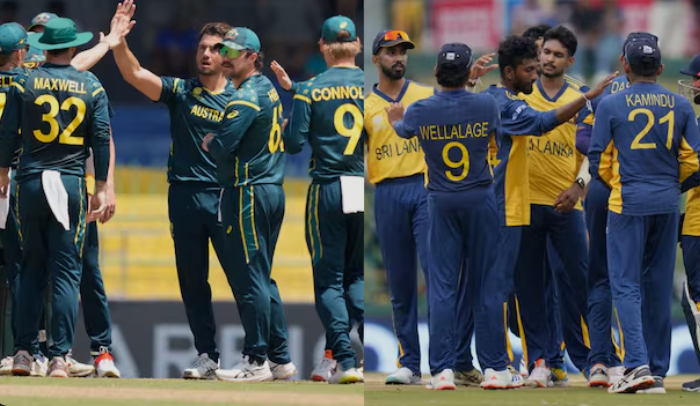
The rivalry between the Sri Lanka National Cricket Team and the Australian Men’s Cricket Team has produced some of cricket’s most memorable encounters. From Australia’s dominance to Sri Lanka’s golden era and modern-day competitive clashes, this timeline reflects a fascinating journey of skill, resilience, and iconic moments across all formats.
Latest Matches
Tournament
Venue
Date
Toss
Sri Lanka Score
Australia Score
Result
Series
Player of the Match
ICC Men’s T20 World Cup 2026
Pallekele International Cricket Stadium, Kandy
Feb 16, 2026
Sri Lanka (field)
184/2 (18 overs)
181 (20 overs)
Sri Lanka won by 8 wickets
ICC Men’s T20 World Cup 2026
Pathum Nissanka (SL)
Bilateral T20I
Colombo
Feb 12, 2026
Australia (bat)
158/6 (20 overs)
154/9 (20 overs)
Sri Lanka won by 4 runs
SL v AUS T20I
Wanindu Hasaranga (SL)
Bilateral T20I
Kandy
Feb 10, 2026
Sri Lanka (field)
142/3 (17.2 overs)
141/8 (20 overs)
Sri Lanka won by 7 wickets
SL v AUS T20I
Matheesha Pathirana (SL)
Bilateral T20I
Kandy
Feb 8, 2026
Australia (field)
165/7 (20 overs)
169/4 (18.5 overs)
Australia won by 6 wickets
SL v AUS T20I
Glenn Maxwell (AUS)
Bilateral ODI
Melbourne
Nov 22, 2025
Sri Lanka (bat)
215 (46.3 overs)
219/2 (34.1 overs)
Australia won by 8 wickets
AUS v SL ODI
Mitchell Starc (AUS)
Bilateral ODI
Sydney
Nov 19, 2025
Australia (field)
288/8 (50 overs)
292/5 (48.2 overs)
Australia won by 5 wickets
AUS v SL ODI
Steven Smith (AUS)
Champions Trophy
Karachi
Jun 14, 2025
Sri Lanka (field)
312/9 (50 overs)
311/8 (50 overs)
Sri Lanka won by 1 run
Champions Trophy
Charith Asalanka (SL)
Bilateral Test
Galle
Jan 29 – Feb 2, 2025
Australia (bat)
212 & 190
413 & 121/0
Australia won by 10 wickets
Warne-Murali Trophy
Nathan Lyon (AUS)
ICC & Asia Cup Matches Timeline
Year
Tournament
Winner
Margin
Key Highlight
2026
T20 World Cup
Sri Lanka
8 wickets
Pathum Nissanka 100* off 52
2023
ODI World Cup
Australia
5 wickets
Australia chased 210
2022
T20 World Cup
Australia
7 wickets
Australia dominant chase
2021
T20 World Cup
Australia
7 wickets
Australia comfortable win
2015
ODI World Cup
Australia
64 runs
Australia strong batting win
2013
Champions Trophy
Sri Lanka
20 runs
Mahela Jayawardene MoM
2010
T20 World Cup
Australia
81 runs
Australia big victory
2009
T20 World Cup
Sri Lanka
6 wickets
Sri Lanka chased successfully
2002
Champions Trophy
Sri Lanka
7 wickets
Aravinda de Silva MoM
1996
ODI World Cup (Final)
Sri Lanka
7 wickets
Historic World Cup win
Top 5 Standout Performances
Rank
Player
Match Details
Performance Details
Impact
1
Pathum Nissanka (SL)
2026 T20 World Cup
100* off 52 balls (10×4, 5×6)
Anchored chase; SL won by 8 wickets & advanced to Super 8; Player of the Match
2
Aravinda de Silva (SL)
2002 Champions Trophy Semi
All-round: Key batting + bowling
Man of the Match; SL won by 7 wickets
3
Mahela Jayawardene (SL)
2013 Champions Trophy
Match-winning batting contribution
Man of the Match; SL won by 20 runs
4
Muttiah Muralitharan (SL)
2002 Champions Trophy Semi
3/26 in 9.4 overs
Restricted Australia to 162; pivotal in SL victory
5
Aravinda de Silva (SL)
1996 ODI World Cup Final
Crucial all-round display
Helped SL secure historic World Cup title win by 7 wickets
Overall Head-to-Head Record
Format
Matches Played
Australia Wins
Sri Lanka Wins
Ties / No Result
Australia Win %
Tests
35
22
5
8 draws
62.86%
ODIs
106
64
38
4
63.36%
T20Is
26
15
10
1
59.61%
Early Encounters: Australia’s Strong Hold (1983–1995)
The rivalry began in the early 1980s when Sri Lanka entered the international cricket scene as a relatively new Test-playing nation. Australia, already a well-established cricketing powerhouse, dominated these early contests with superior experience and depth. Sri Lanka struggled to match Australia’s pace attack and batting strength, particularly in overseas conditions. However, Sri Lanka showed flashes of brilliance, especially in home conditions where spin-friendly pitches provided some advantage. These early encounters were crucial for Sri Lanka’s development, as they learned to compete against one of the best teams in the world. Australia’s consistent victories defined this phase, but Sri Lanka’s gradual improvement hinted at a more competitive future.
Year
Event
Winner
Venue
1983
ODI Series
Australia
Australia
1987
World Cup
Australia
India
1995
Test Series
Australia
Sri Lanka
Sri Lanka’s Golden Rise (1996–2003)
The late 1990s marked a turning point in the rivalry as Sri Lanka emerged as a dominant force in world cricket. Their victory in the 1996 World Cup transformed their confidence and approach to the game. Sri Lanka began challenging Australia more effectively, especially in home conditions. Their aggressive batting and strong spin attack made matches more competitive. Australia remained a powerful team, but Sri Lanka’s rise added a new dimension to the rivalry. This period saw several thrilling encounters, with both teams producing high-quality cricket. Sri Lanka’s success during this era established them as a formidable opponent, reducing the gap between the two sides significantly.
Year
Series/Event
Winner
Highlight
1996
World Cup
Sri Lanka
Historic Win
1999
Test Series
Australia
Competitive Matches
2003
World Cup
Australia
Strong Campaign
The 2000s: Intense Battles and Balance (2004–2010)
Between 2004 and 2010, the rivalry became highly competitive, with both teams enjoying periods of dominance. Australia maintained its reputation as a top team with consistent performances, while Sri Lanka relied on experienced players and strong home advantage. Matches during this period were closely contested, often featuring dramatic finishes. Sri Lanka’s spin attack posed challenges for Australia, while Australia’s pace and aggressive batting tested Sri Lanka’s resilience. This era highlighted the balance between the teams, making their encounters exciting for fans. The rivalry gained global attention due to the quality and intensity of matches played across formats.
Year
Event
Winner
Highlight
2004
Test Series
Sri Lanka
Home Strength
2007
World Cup Final
Australia
Dominant Win
2009
ODI Series
Sri Lanka
Close Matches
Modern Rivalry: Australia’s Consistency vs Sri Lanka’s Flair (2011–2018)
From 2011 to 2018, the rivalry remained competitive, with Australia often holding a slight edge due to their consistency across formats. Sri Lanka continued to challenge strongly, especially at home, where their spin bowlers and experienced players delivered impressive performances. Matches were often closely fought, reflecting the competitive nature of both teams. This era also saw increased global interest in their encounters, as both sides featured world-class talent. While Australia maintained a strong record overall, Sri Lanka’s ability to secure key victories kept the rivalry balanced and engaging.
Year
Series/Event
Winner
Highlight
2011
World Cup
Sri Lanka
Strong Campaign
2015
World Cup
Australia
Dominance
2016
Test Series
Sri Lanka
Historic Whitewash
Recent Years: Competitive and Evolving (2019–Present)
In recent years, the rivalry has continued to evolve, with both teams undergoing transitions and introducing new talent. Australia has maintained strong performances with a balanced squad, while Sri Lanka has focused on rebuilding and developing young players. Matches remain competitive, with both teams capable of delivering strong performances. Sri Lanka’s home advantage continues to play a crucial role, while Australia’s adaptability ensures they remain a formidable opponent. This period reflects the ongoing evolution of the rivalry, with both teams striving to achieve consistency and success on the global stage.
Year
Series/Event
Winner
Highlight
2019
Bilateral Series
Australia
Strong Squad
2022
Test Series
Sri Lanka
Close Contest
2024
Recent Matches
—
Competitive Games
Key Players and Legendary Performances
The Sri Lanka vs Australia rivalry has been defined by legendary players who delivered unforgettable performances. Sri Lanka has produced icons like Kumar Sangakkara and Muttiah Muralitharan, while Australia has relied on greats such as Ricky Ponting and Shane Warne. These players have shaped the rivalry with their exceptional skills and match-winning performances. Their contributions have created iconic moments and elevated the intensity of contests between the two teams.
Player
Team
Era
Contribution
Kumar Sangakkara
Sri Lanka
2000s–2010s
Batting Excellence
Muttiah Muralitharan
Sri Lanka
1990s–2010s
Spin Wizard
Ricky Ponting
Australia
1990s–2000s
Leadership
Shane Warne
Australia
1990s–2000s
Spin Bowling
Future Outlook: A Rivalry That Continues to Grow
The future of the Sri Lanka vs Australia rivalry looks promising as both teams continue to develop new talent and compete in international tournaments. Regular encounters in ICC events and bilateral series will keep the rivalry alive. Sri Lanka’s rebuilding phase and Australia’s consistent performance ensure competitive matches. With emerging players stepping up, future contests are expected to be even more exciting. This rivalry represents the spirit of cricket, combining tradition, skill, and passion to create unforgettable sporting moments.
Aspect
Sri Lanka
Australia
Impact
Strength
Spin Attack
All-round Strength
Balanced Rivalry
Challenge
Consistency
Subcontinent Conditions
Close Matches
Future
Emerging Talent
Strong System
Exciting Games
Conclusion
The timeline of the Sri Lanka National Cricket Team vs Australian Men’s Cricket Team rivalry highlights a journey of growth, dominance, and intense competition. From Australia’s early control to Sri Lanka’s golden era and modern-day balanced contests, the rivalry has produced memorable matches and legendary performances. Both teams have contributed to the global appeal of cricket with their unique styles and competitive spirit. As they continue to face each other on the international stage, their encounters promise excitement and high-quality cricket. This rivalry remains an important part of cricket history, showcasing the evolution and passion of the sport.