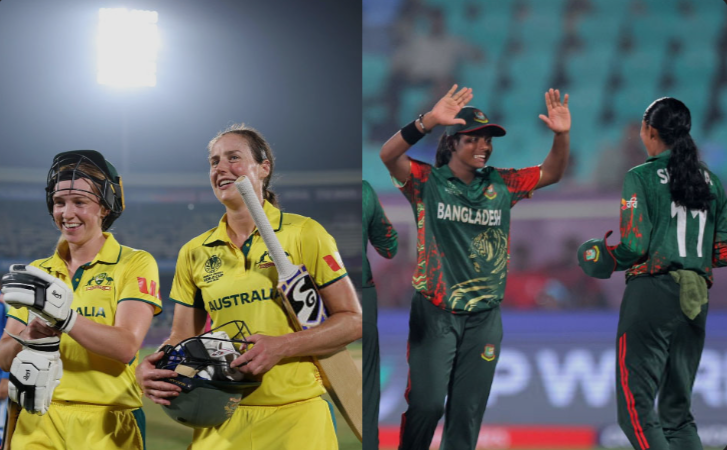
The rivalry between the Bangladesh Women’s National Cricket Team and the Australia Women’s National Cricket Team highlights the contrast between a rising cricket nation and a dominant global powerhouse. While Australia has long ruled women’s cricket, Bangladesh’s steady progress has added new layers of competitiveness. This timeline explores their journey through growth, dominance, and emerging challenges.
Recent Head-to-Head Dominance
Date
Match
Venue
Result
Score
16 Oct 2025
17th Match, ICC Women’s World Cup 2025
Visakhapatnam, India
Australia Women won by 10 wickets
BAN W 198/9 (50 overs) AUS W 202/0 (24.5 overs)
04 Apr 2024
3rd T20I
Sher-e-Bangla National Stadium, Mirpur, Dhaka
Australia Women won by 77 runs
AUS W 155/6 (20 overs) BAN W 78 (18.1 overs)
02 Apr 2024
2nd T20I
Sher-e-Bangla National Stadium, Mirpur, Dhaka
Australia Women won by 58 runs
AUS W 161/8 (20 overs) BAN W 103/9 (20 overs)
31 Mar 2024
1st T20I
Sher-e-Bangla National Stadium, Mirpur, Dhaka
Australia Women won by 10 wickets
BAN W 126/4 (20 overs) AUS W 127/0 (13 overs)
27 Mar 2024
3rd ODI
Sher-e-Bangla National Stadium, Mirpur, Dhaka
Australia Women won by 8 wickets
BAN W 89 (26.2 overs) AUS W 93/2 (18.3 overs)
24 Mar 2024
2nd ODI
Sher-e-Bangla National Stadium, Mirpur, Dhaka
Australia Women won by 6 wickets
BAN W 97 (44.1 overs) AUS W 98/4 (23.5 overs)
21 Mar 2024
1st ODI
Sher-e-Bangla National Stadium, Mirpur, Dhaka
Australia Women won by 118 runs
AUS W 213/7 (50 overs) BAN W 95 (36 overs)
Year-Wise Key Matches Timeline
Year
Matches Played
ODIs
T20Is
Australia Women Wins
Bangladesh Women Wins
2025
1
1
0
1
0
2024
6
3
3
6
0
2023
1
0
1
1
0
2022
1
1
0
1
0
Tournament-Wise Encounters Timeline
Tournament / Series
Year
Date
Format
Result
Margin / Score Details
Venue
ICC Women’s World Cup 2025
2025
16 Oct 2025
ODI
Australia Women won
By 10 wickets BAN W 198/9 (50) – AUS W 202/0 (24.5)
Visakhapatnam, India
Australia Tour of Bangladesh 2024 (ODI Series)
2024
21–27 Mar 2024
ODI (3 matches)
Australia Women won all 3
118 runs, 6 wickets, 8 wickets
Sher-e-Bangla Stadium, Mirpur, Dhaka
Australia Tour of Bangladesh 2024 (T20I Series)
2024
31 Mar – 04 Apr 2024
T20I (3 matches)
Australia Women won all 3
10 wickets, 58 runs, 77 runs
Sher-e-Bangla Stadium, Mirpur, Dhaka
ICC Women’s T20 World Cup 2023
2023
14 Feb 2023
T20I
Australia Women won
By 8 wickets AUS W 111/2 (18.2) – BAN W 107/7 (20)
St George’s Park, Port Elizabeth, South Africa
ICC Women’s World Cup 2022
2022
25 Mar 2022
ODI
Australia Women won
By 5 wickets (D/L) BAN W 135/6 (43) – AUS W 136/5 (32.1)
66* (75 balls) – anchored the chase under D/L method
Early Encounters and Australia’s Complete Dominance (2007–2015)
The initial meetings between Bangladesh Women and Australia Women were heavily dominated by Australia. With a world-class setup, experienced players, and a strong domestic structure, Australia consistently outperformed Bangladesh in all formats. Bangladesh, still developing its women’s cricket program, struggled to match the skill level and tactical depth of their opponents. Matches were largely one-sided, with Australia showcasing superior batting, disciplined bowling, and sharp fielding. However, these encounters were crucial for Bangladesh’s development, as they gained valuable exposure to top-level cricket. This phase firmly established Australia’s dominance while laying the foundation for Bangladesh’s long-term growth.
Period
Matches
Dominant Team
Key Feature
2007–2010
ICC Events
Australia
Experience Gap
2011–2015
Bilateral
Australia
One-sided Results
Bangladesh’s Development and Learning Phase (2016–2019)
Between 2016 and 2019, Bangladesh Women began showing gradual improvement. Their performances became more structured, with better batting discipline and improved bowling strategies. While Australia continued to dominate results, Bangladesh started competing in phases of matches, occasionally putting pressure on their opponents. This period was about learning and adaptation, as Bangladesh gained confidence through international exposure. Australia’s consistency and depth ensured they remained far ahead, but Bangladesh’s progress hinted at a more competitive future. These encounters reflected the early stages of narrowing the gap between the two teams.
Year Range
Development
Leading Team
Highlight
2016–2017
Skill Growth
Australia
Competitive Phases
2018–2019
Confidence Rise
Australia
Improved Performance
ICC Tournament Clashes and Global Exposure (2020–2022)
This phase saw Bangladesh and Australia meet in major ICC tournaments, bringing global attention to their rivalry. Australia’s experience in high-pressure matches often proved decisive, as they maintained their winning record. However, Bangladesh displayed resilience and determination, showing signs of growth in their gameplay. Matches during this period were played with greater intensity, as Bangladesh aimed to challenge one of the best teams in the world. These encounters highlighted the importance of experience and consistency, while also showcasing Bangladesh’s steady improvement on the international stage.
Year
Event
Winner
Highlight
2020
ICC Event
Australia
Tactical Dominance
2021–2022
Tournaments
Australia
Strong Control
Rising Competitiveness and Improved Performances (2023–Present)
In recent years, Bangladesh Women have made noticeable progress, making matches against Australia more competitive. While Australia still holds a strong advantage, Bangladesh has shown improved batting depth and more disciplined bowling. Matches are now more engaging, with Bangladesh occasionally challenging Australia in key moments. The influence of T20 cricket has also made games faster and more dynamic. This phase reflects the evolution of Bangladesh as a competitive team, even though Australia continues to dominate overall.
Year
Format
Winner
Event
2023
T20/ODI
Australia
Competitive Matches
2024
Series
Australia
Improved Bangladesh
2025–Present
Multi-format
Ongoing
Growing Rivalry
Key Players and Match-Winning Performances
The Bangladesh Women vs Australia Women rivalry has featured several outstanding players. Australia has relied on stars like Meg Lanning and Ellyse Perry, while Bangladesh has produced key performers such as Nigar Sultana and Salma Khatun. These players have played vital roles in shaping matches, with Australia’s consistency often proving decisive and Bangladesh’s resilience adding competitive spirit.
Player
Team
Role
Contribution
Meg Lanning
Australia
Batter
Leadership
Ellyse Perry
Australia
All-rounder
Match Winner
Nigar Sultana
Bangladesh
Batter
Captaincy
Salma Khatun
Bangladesh
All-rounder
Experience
Australia’s Dominance vs Bangladesh’s Growth Story
This rivalry perfectly represents the broader landscape of women’s cricket. Australia stands as a benchmark for excellence, with a highly professional system and consistent performances. Bangladesh, on the other hand, represents a rising force, steadily improving through hard work and international exposure. Matches between the two teams highlight the gap in experience but also the potential for growth. Bangladesh’s journey against a dominant team like Australia serves as a learning curve and a motivation to improve further.
Aspect
Australia
Bangladesh
Impact
Strength
World-class
Developing
Competitive Growth
Experience
High
Moderate
Learning Curve
Future
Stable
Rising
Exciting Potential
Future Outlook and Expanding Rivalry
Looking ahead, the Bangladesh Women vs Australia Women rivalry is expected to grow stronger. Bangladesh’s steady improvement suggests that future matches will become more competitive. Australia, with its strong foundation, will continue to be a dominant force. Increased opportunities through ICC tournaments and bilateral series will provide more chances for Bangladesh to challenge top teams. This rivalry reflects the expanding reach of women’s cricket and the closing gap between established and emerging nations.
Factor
Bangladesh
Australia
Impact
Talent
Emerging
Elite
Competitive Matches
Form
Improving
Consistent
Australia Edge
Future
Promising
Strong
Growing Rivalry
Conclusion
The timeline of the Bangladesh Women vs Australia Women’s National Cricket Team rivalry highlights a journey of dominance and development. While Australia has consistently led the contest with world-class performances, Bangladesh’s steady progress has added competitiveness to their encounters. These matches reflect the broader evolution of women’s cricket, where emerging teams are gradually closing the gap with established powers. With improving skills, growing confidence, and increased global exposure, Bangladesh is poised to challenge stronger teams more effectively in the future. As both sides continue to evolve, this rivalry promises exciting matches and plays a vital role in shaping the future of women’s international cricket.